
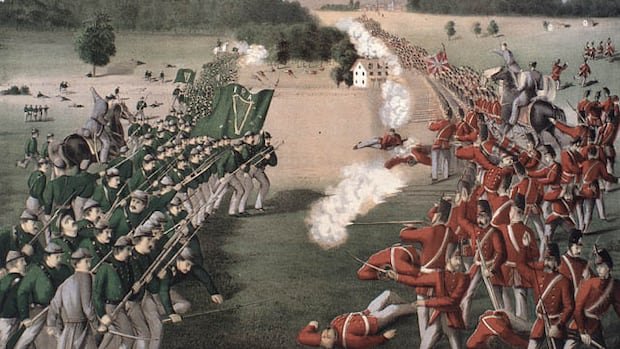

An overlooked conflict that occurred on Canadian territory just before Confederation might not resonate widely in the historical memory of Canadians beyond Fort Erie, Ontario. However, the Battle of Ridgeway, also known as Limestone Ridge, in 1866 holds significant historical significance. It marked the first instance where Canadian forces, led by Canadian officers, engaged in combat. Moreover, it served as the inspiration for Decoration Day, a precursor to Remembrance Day observed in various parts of the nation.
Despite these historical milestones, the nine individuals who lost their lives in the battle are not included in the Books of Remembrance, a collection on Parliament Hill commemorating soldiers who perished while serving Canada. A new petition set to be presented in the House of Commons aims to have these nine individuals and the numerous others who died following the battle added to the list.
Conservative MP Fred Davies, who represents the Niagara South riding encompassing Fort Erie, where the battle unfolded, emphasized the importance of recognizing those who made the ultimate sacrifice to defend Canada. Reflecting on the battle, which saw inexperienced volunteers confronting Fenian raiders, Davies highlighted the valor displayed by those who fought to protect their homeland against an invading force.
Historian Peter Vronsky, author of the book “Ridgeway: The American Fenian Invasion And The 1866 Battle That Made Canada,” commended the swift mobilization of Canadian volunteers from the Golden Horseshoe region, albeit underscoring the lack of preparation for what he termed Canada’s inaugural modern battle. Despite facing challenges such as shortages in provisions and ammunition, the Canadian troops engaged the invaders in combat, ultimately repelling the Fenian incursion.
While the Battle of Ridgeway ended in a battlefield defeat for the Canadians, the campaign’s disruption marked a symbolic victory as it thwarted the Fenian raiders’ advance. The sacrifice of those who perished in the battle, though not resulting in a tactical triumph, underscores their dedication to defending Canada against external threats.
Efforts to honor the memory of the fallen soldiers include a memorial site erected in 2016 commemorating the nine individuals who lost their lives at Ridgeway. Local authorities, such as Fort Erie Mayor Wayne Redekop, have advocated for their inclusion in the Books of Remembrance as recognition of their contribution to shaping Canada’s history.
Despite occurring before the formal establishment of Canada, the Battle of Ridgeway holds significance in the nation’s narrative, influencing the path to Confederation. Vronsky emphasized that the battle galvanized reluctant individuals to support the notion of a unified Canada, symbolizing a pivotal moment in the country’s evolution.
The legacy of the Battle of Ridgeway endures through regiments like the Queen’s Own Rifles and the Royal Hamilton Light Infantry, which participated in the 1866 conflict. Notably, figures such as Alexander Muir, renowned for composing “The Maple Leaf Forever,” were among those who fought in the battle, embodying a sense of national pride and unity.