

A groundbreaking discovery has been made by scientists who have unveiled remarkable new maps providing an unparalleled view beneath the enigmatic icy surface of Antarctica.
Previously, our knowledge of the subglacial landscape of Earth’s fifth-largest continent lagged behind that of the Moon’s surface. However, a dedicated team of researchers has now generated the most intricate map ever created of the hidden terrain lying beneath the Antarctic Ice Sheet. This detailed map exposes a concealed world of mountains, valleys, and river beds, presenting vital insights for predicting future sea-level changes.
Published in the journal Science, the study documents the meticulous process of digitally removing the ice cover to reveal geological formations that have been unseen for millions of years.
Professor Robert Bingham, a glaciologist at the University of Edinburgh and co-author of the study conducted in collaboration with the University of Grenoble-Alpes, expressed his enthusiasm to the BBC, stating, “I’m thrilled to witness the complete bed of Antarctica all at once. I find that truly remarkable.”
The newly-released maps depict a landscape reminiscent of the striking terrain of the Alps, hidden beneath the Antarctic glaciers.
These maps showcase the elevation below or above sea level, unveiling significant variations across thousands of miles and highlighting major peaks.
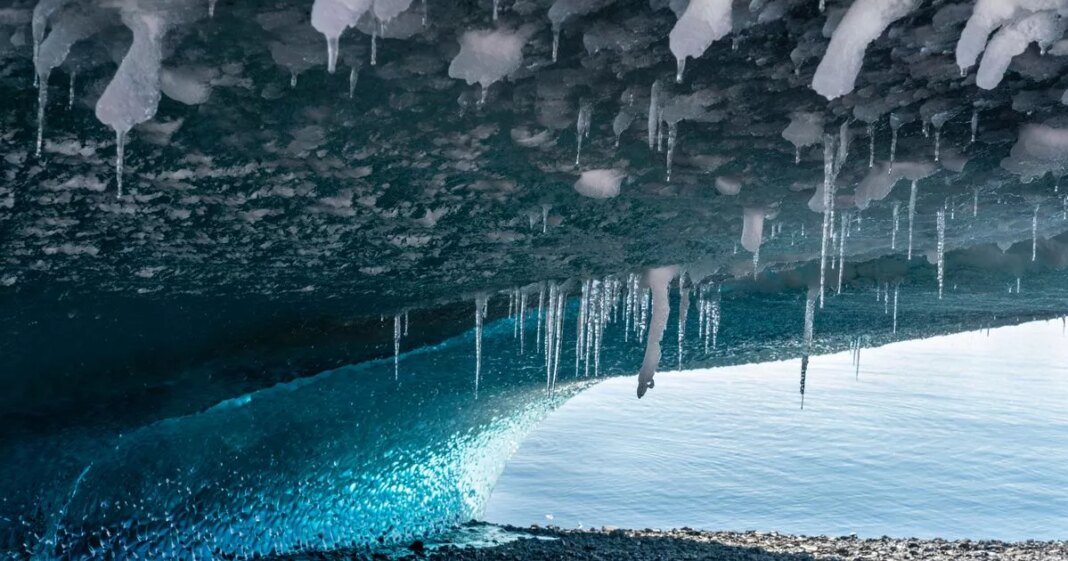
Numerous ice caves, some of which are quite dramatic, are featured in many of Antarctica’s glaciers.
One of the maps delves into Antarctica’s notable landmarks, such as the Hercules Dome and Zhigalov Subglacial Highlands.
An ice cave formed by volcanic vents near the summit of Mt Erebus, Antarctica, is explored by a scientist.
This map provides diverse measurements of the continent’s diverse landscape.
This research will enhance scientists’ understanding of the potential ice melting from each glacier as temperatures continue to rise.
The latest findings enable researchers to gain a comprehensive understanding of the various types of landscapes present across Antarctica
By scrutinizing high-resolution satellite images of the ice surface, scientists have identified minute elevations and depressions that mirror the rugged topography buried kilometers below.