
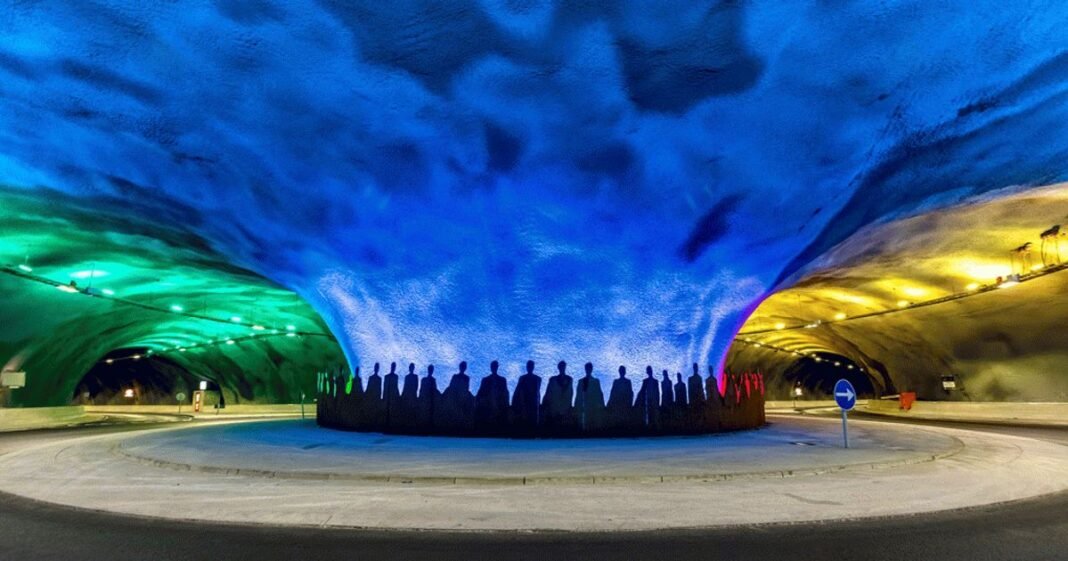

Beneath the waters of the Atlantic Ocean lies a unique undersea roundabout, affectionately known as the “jellyfish,” connecting the Faroe Islands’ largest islands. Situated within the Eysturoyartunnil tunnel, this colorful traffic circle stands out as a remarkable engineering feat, resembling a jellyfish.
This subsea tunnel, spanning 6.9 miles, offers a swift connection between Streymoy and Eysturoy islands, with a quick eight-minute drive through its depths. At its core lies the world’s first underwater roundabout, attracting attention for its vibrant lights and distinctive design. The roundabout features changing hues of blue, red, and green, with shadowy figures adding to its eerie ambiance.
At the center of this aquatic roundabout stands a massive illuminated pillar of natural rock, an artistic creation by Faroese artist Tróndur Patursson. Surrounding the pillar is an elaborate 80-meter steel sculpture depicting life-sized figures holding hands in unity, symbolizing collaboration and progress in Faroese culture.
Opened in December 2020, the Eysturoyartunnil tunnel network aims to enhance connectivity and economic development in the Faroe Islands. By halving the travel time between Tórshavn and Klaksvik, the tunnel significantly improves accessibility between the island’s major cities. With a depth of 189 meters at its lowest point, the tunnel boasts three tubes converging at the visually striking roundabout.
Constructed by Eystur- og Sandoyartunlar, this tunnel project represents the largest investment in the Faroe Islands to date, totaling approximately €260m (£230m). Motorists traversing this deep-sea passage are required to pay a toll fee of 75 Danish krona (£8.60) each way, automatically billed through license plate scanning. Anticipated revenue from the tunnel will fund future infrastructure projects in the region.
Guðrið Højgaard, director of Visit Faroe Islands, envisions the tunnel benefiting tourism across the northeastern part of the islands and fostering greater hospitality for visitors. This innovative infrastructure is poised to reshape transportation and tourism dynamics in the Faroe Islands, paving the way for further development and connectivity in the region.