
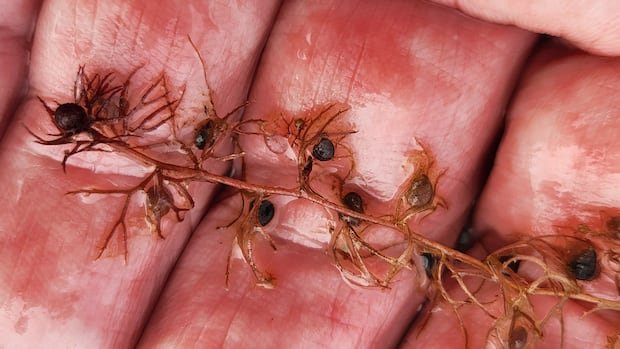

Plant enthusiast Klaus Koehler made an unusual discovery while exploring the Sylvia Grinnell Territorial Park near Iqaluit in July. He stumbled upon a rare plant species not commonly found in Arctic regions, raising concerns about the potential impact of invasive species moving into Northern ecosystems as the climate changes.
During his walk, Koehler reached into a pond and retrieved a peculiar brownish plant known as bladderwort. Although inconspicuous to the untrained eye, Koehler recognized the unique characteristics of the plant.
Covered with small black bladders containing partially digested flies, the carnivorous bladderwort is typically found in more temperate climates and seldom ventures into tundra territories. The last documented sighting of this plant in the area dates back to 2012 when researchers discovered samples near Kimmirut, approximately 120 kilometers southwest of Iqaluit.
Koehler’s observation hints at a shifting climate in the region. While the Arctic has traditionally hosted few invasive species due to its harsh conditions, rising temperatures are now creating a more favorable environment for unfamiliar plant species to establish themselves in the area.
The prolonged summers and milder winters are extending the growing season in the Arctic, prompting concerns about potential disruptions to the local ecosystem. Experts, including Paul Sokoloff from Ottawa’s Museum of Nature, warn that the influx of non-native plants could outcompete indigenous species, altering the delicate balance of the Arctic flora.
The introduction of invasive species poses a significant threat to Arctic biodiversity, with seeds being dispersed by birds, ships, and human activities. Sokoloff emphasizes the need to prevent a scenario similar to the invasion of phragmites, a destructive grass species from Eurasia that has plagued Ontario’s ecosystems for years.
While Koehler’s discovery is unlikely to have immediate detrimental effects, the broader implications of invasive plant species spreading into the Arctic are a cause for concern. Research suggests that thousands of plant species could potentially encroach on Arctic habitats, jeopardizing the native flora.
To further investigate the expansion of bladderwort in Iqaluit, Koehler plans to send a sample to the Museum of Nature for detailed analysis. This collaborative effort aims to enhance scientific understanding of the plant’s northward migration and its implications for Arctic ecosystems.