
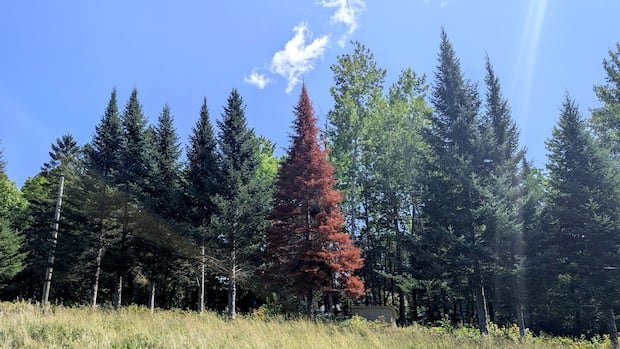

Balsam fir trees in New Brunswick are exhibiting red discoloration and dying following a severe drought last summer, sparking concerns about the fate of the provincial tree. Professor Anthony Taylor, a forestry researcher at the University of New Brunswick, has been closely monitoring reports from woodlot owners and witnessing the detrimental effects firsthand as the vibrant evergreens, often sought after as Christmas trees, gradually transition to a red, desiccated state leading to their demise.
According to Taylor, the observed pattern aligns with previous instances following hot, arid summers, where warm and dry conditions like the preceding year’s drought negatively impact the growth capacity of balsam fir trees. Having extensively studied the influence of climate change on New Brunswick’s forests over the years, Taylor notes that similar die-offs of balsam firs occurred after exceptionally warm, dry summers in 1986 and 2018.
The adverse effects of drought prompt the trees to prematurely halt the photosynthesis process in response to the arid conditions, impeding their growth. This disruption inhibits the production of essential energy stores necessary for sustaining basic metabolic functions and generating defense compounds, rendering the trees vulnerable. Taylor emphasizes that stressed trees, whether by insects or pathogens, face an increased risk of perishing due to their compromised state.
Furthermore, balsam firs possess shallow root systems, exacerbating their challenge in accessing water during dry periods. Peter McKeil, a woodlot owner, observed the development of red discoloration starting from the lower branches of the trees on his property, with new affected areas emerging continuously. He estimates a loss of approximately 100 trees so far and has adjusted his harvesting methods to salvage value from the remaining firs before further deterioration.
McKeil voices concerns about the inevitable fate of the species in the face of escalating climate change, particularly in southern New Brunswick, expressing a belief that adaptation or disappearance may be the only options. Acknowledging the visible impact of climate change on the balsam firs, Taylor emphasizes the urgent need for climate action, likening the situation to a warning sign akin to a canary in a coal mine. He emphasizes the necessity of transitioning away from fossil fuels and implementing sustainable forestry practices to mitigate the effects of climate change on vital ecosystems.