
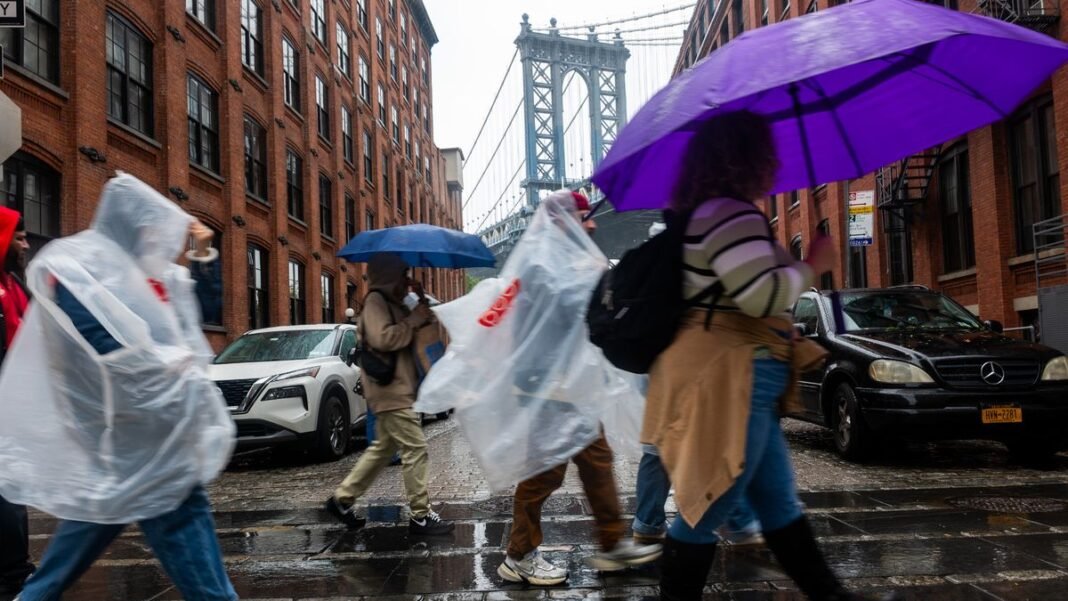

New York has announced a state of emergency statewide in anticipation of an impending “catastrophic” winter storm approaching the United States.
During a press briefing on Friday, Governor Kathy Hochul officially declared the state of New York ready for the massive storm that is forecasted to sweep across the nation over the upcoming weekend. Hochul assured that the state has an ample supply of salt to treat roads and has authorized all state employees to work remotely on Monday.
With a low-pressure system in the Southwest colliding with moisture from the Gulf of Mexico and frigid Arctic air from Canada, 14 states, including New York, have already declared emergencies to brace for heavy snow, ice, and freezing rain.
The National Weather Service (NWS) reported that the storm, originating over the Rocky Mountains and Great Plains, is expected to impact southern and midwestern states starting on Friday before progressing to the east coast by Saturday and reaching as far north as Maine by Sunday.
The NWS cautioned that the storm will bring widespread heavy snow, sleet, and freezing rain from the Southern Rockies to New England, covering regions from Texas through Washington DC, New York, and Boston.
Approximately 160 million people, nearly half of the country’s population across 30 states, are likely to be affected by the snow and ice, with some areas anticipating over 12 inches of snow by the weekend’s end. States that have declared emergencies encompass Alabama, Arkansas, Georgia, Kansas, Kentucky, Louisiana, Mississippi, Missouri, New York, North Carolina, South Carolina, Tennessee, Texas, and Virginia.
The winter storm is a combination of heavy snow, blowing snow, and/or hazardous wind chills, as outlined by the NOAA’s National Severe Storms Laboratory.
The NWS warned of significant to potentially catastrophic ice accumulations, leading to extended power outages, widespread tree damage, and treacherous travel conditions. Following the storm, communities from the Southern Plains to the Northeast will face bitterly cold temperatures and hazardous wind chills, resulting in prolonged dangerous travel conditions and infrastructure impacts.
US President Donald Trump, known for his climate crisis denial, commented on Truth Social, highlighting the expected record cold wave affecting 40 states and questioning the concept of global warming.
Meteorologists attribute the Polar Vortex, a vast area of low pressure and cold air around the poles, for driving Arctic air across North America. Scientific research suggests that Arctic warming can disrupt the polar vortex, potentially causing it to stretch or split, leading to an uptick in extreme winter weather incidents.