
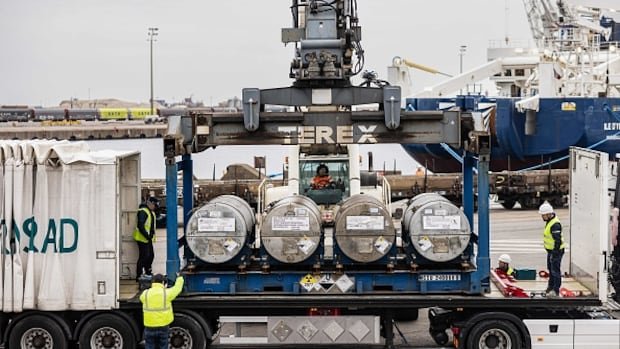

In the midst of the Russian military’s control over Ukraine’s largest nuclear plant and assaults on the country’s power infrastructure, European and American reliance on Russian nuclear fuel for powering their electricity networks persists.
One of the recipients of low enriched uranium (LEU) from Russia for fueling commercial nuclear reactors in the U.S. is Canadian-owned Westinghouse Electric, as per shipping data scrutinized by CBC’s investigative team, the fifth estate.
In August 2024, the U.S. prohibited the import of Russian enriched uranium to reduce dependency on Russian materials and secure a robust domestic fuel supply, according to the U.S. Department of Energy (DOE). Nonetheless, the Prohibiting Russian Uranium Imports Act permits the DOE to waive the ban in cases where no viable alternative source of LEU is available or if the import is deemed in the national interest. These waivers are set to expire by January 1, 2028.
A report by the Bellona Environmental Transparency Center in Vilnius, Lithuania, disclosed that in 2025 alone, the U.S. imported 400 tonnes of low enriched uranium from Russia valued at around $1 billion US. Major recipients included subsidiaries of French-owned Framatome (over 127 tonnes), U.S.-based Global Nuclear Fuel Americas (more than 110 tonnes), and Westinghouse (approximately 27 tonnes).
While the U.S. took measures, such as the import ban, Europe has not implemented restrictions on Russian enriched uranium imports. Similarly, Canada has not sanctioned engaging in business with Russia’s state atomic energy corporation Rosatom or its export entity, Tenex.
According to Dmitry Gorchakov, a nuclear advisor at Bellona, countries should strive to decrease their reliance on Russia and terminate all potential collaborations, especially amidst the ongoing conflict and direct threat to Ukraine.
The fifth estate’s analysis of shipping data between Westinghouse and Tenex revealed that Moscow-based Tenex exported varying quantities of uranium from Russia to Westinghouse’s fuel fabrication plant in South Carolina over the four-year period of the Ukraine conflict.
In March this year, Tenex reportedly delivered 50,612 kilograms of uranium to Westinghouse in four containers, originating from Russia’s St. Petersburg port and arriving in Baltimore, U.S.
The enriched uranium received at Westinghouse’s South Carolina facility undergoes processing into fuel pellets before being assembled into fuel rod units for commercial nuclear power reactors.
Westinghouse Electric, with majority ownership by Brookfield Renewable Partners and Saskatchewan-based Cameco Corporation, plays a significant role in the U.S. nuclear industry. Despite being contacted, Westinghouse and Brookfield did not provide responses to inquiries for this story.
U.S. lobbyist disclosures indicated that Cameco lobbied on the Prohibiting Russian Uranium Imports Act in Washington. However, Cameco clarified that it does not handle enriched uranium and directed queries to individual U.S. utilities.
The U.S. Energy Information Administration refrains from disclosing the total amount of uranium purchased from Russia, citing data privacy protections. Nevertheless, the administration’s latest report noted Russia as the primary foreign provider of uranium enrichment services to the U.S. in 2025.
Continued…