
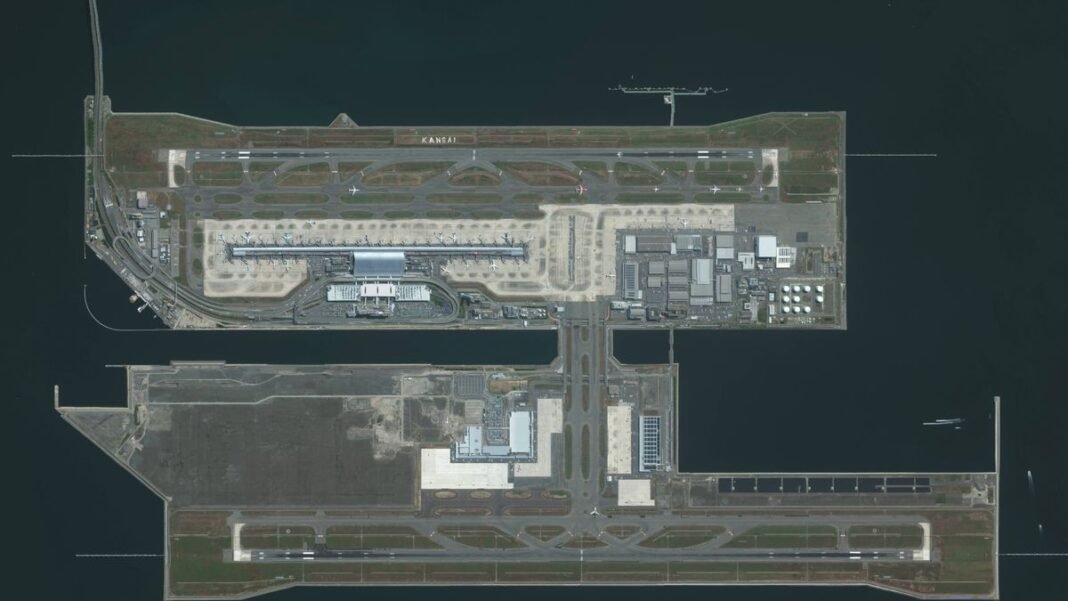

A world-renowned airport that broke records is facing a troubling scenario of sinking beneath the ocean’s surface in the next century. Kansai International Airport, situated on one of two man-made islands in Japan’s Osaka Bay, was constructed on a seabed primarily composed of alluvial clay, a material prone to gradual compression.
Opened to passengers 32 years ago in 1994, the airport was initially projected to subside around 13 feet over 50 years. However, it has sunk much faster, dropping an alarming 42 feet instead. Despite the sinking issue, the airport has been handling a growing volume of air traffic, with 169,774 take-offs and landings recorded in 2024, serving 25.9 million travelers.
Yukako Handa, the former communications director of Kansai Airports, discussed the unexpected subsidence levels compared to projections, highlighting the soil reclamation and subsidence estimation done during the airport’s construction. Engineers attempted to counter the sinking by installing sand drains, but the sinking persisted at a faster rate than expected.
To address the sinking, additional funding of £112 million was invested to fortify the seawall surrounding the airport, which helped slow down the subsidence. Current predictions suggest that if the sinking persists, the airport could dip below sea level by 2056. Being close to sea level exposes the airport to storm surges and seismic events.
Despite its potential challenges, Kansai International Airport has also gained recognition for its exceptional performance. In 2024, it achieved a remarkable milestone of not losing a single piece of luggage in three decades of operation, earning accolades such as the ‘World’s Best Airport for Baggage Delivery’ at the prestigious Skytrax World Airport Awards.