
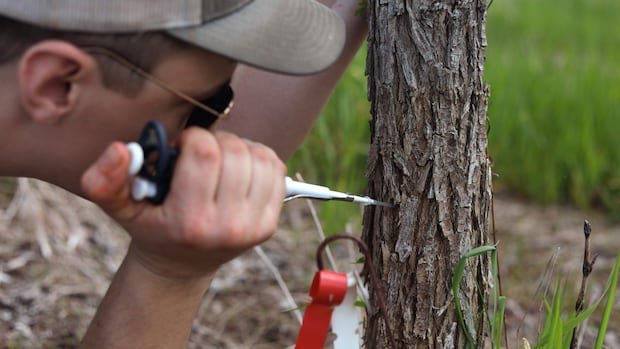

Scientists in Vermont have been actively infecting thousands of trees with Dutch elm disease this summer. This unusual initiative is part of a project by the U.S. Forest Service and the Nature Conservancy to test the resistance of a new generation of elms bred from disease survivors. The aim is to rebuild elm populations that have been decimated by the fungus spread by bark beetles in the U.S. and Canada for many years.
The loss of elm trees over the years has been significant, according to Gus Goodwin, a senior conservation planner at The Nature Conservancy. The experiment in Vermont, alongside similar efforts in Canada, seeks to create disease-resistant elms as Dutch elm disease poses a growing threat in new regions.
In Fredericton, once known as the “City of Stately Elms,” the disease wiped out around 10,000 trees in the 1960s and 70s, leaving only about 1,000 mature elms today. Professor Anthony Taylor, a forest management expert, laments the recurrence of the disease affecting even the surviving elms on his property.
The disease spreads when bark beetles carrying the spores infect the trees, leading to the blockage of the water-conducting tissues and eventual death of the tree within a few years. To combat Dutch elm disease, infected trees must be promptly removed to prevent further spread. However, past practices like the mass removal of healthy elms may have unintentionally impacted the population’s ability to resist the disease.
Cities across North America, from Manitoba to the Maritimes, are facing the resurgence of Dutch elm disease, with Edmonton and Saskatoon reporting increasing cases in recent years. Efforts to manage and mitigate the disease involve swift tree removal and community cooperation to prevent its spread.
While the future of elm trees remains uncertain, researchers are hopeful that their breeding and cloning efforts will lead to the development of disease-resistant elms. This long-term project involves testing thousands of seedlings for their resilience to Dutch elm disease, with the goal of restoring elm populations that can coexist with the fungus, similar to elms in Europe. The process may take years, but the potential benefits in restoring elm-lined streets and enhancing urban ecosystems are promising.