
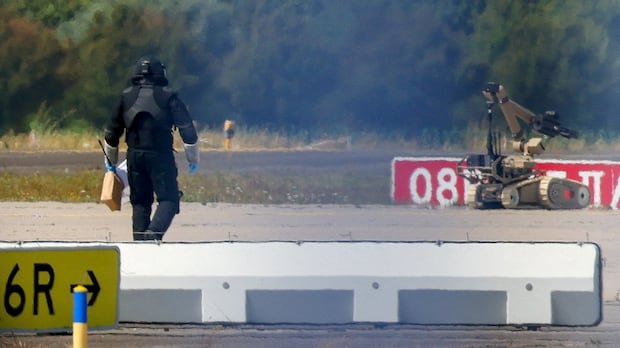

German authorities are currently investigating a drone equipped with explosives and a detonator discovered at Leipzig airport, while Russian Foreign Minister Sergey Lavrov has indicated Moscow’s intention to escalate retaliatory actions against countries supporting Ukraine.
In an interview with VGTRK, Russia’s state media, Lavrov stated, “We will employ more severe measures to dismantle all support for Kyiv’s military capabilities from the West. We are already taking action.”
The drone, containing an unknown explosive device, was found by an airport employee in the cargo operations zone’s security area near Leipzig airport’s south runway, classified as critical infrastructure. Leipzig serves as a crucial NATO airport for transporting armaments, ammunition, weapons, and military equipment to Ukraine via flights operated by Ukrainian cargo firms.
The presence of the drone next to a Ukrainian cargo plane has raised concerns in Germany, with the country’s interior minister referring to it as a “new level of danger.” Alexander Dobrindt noted that the incident appeared to be part of a sophisticated hybrid threat scenario rather than the work of amateurs.
While German authorities are investigating the origin of the drone, U.S. intelligence sources have suggested a potential link to the Russian government. Berlin is taking a cautious approach, enhancing anti-drone capabilities and refraining from premature accusations.
German officials warn of Russia’s utilization of drones, espionage, sabotage, and influence operations across Europe, particularly in the lead-up to upcoming regional elections in Germany. Dobrindt emphasized the ongoing threats faced by Germany, denoting the country as a daily target of hybrid warfare tactics.
Recent years have seen instances of Russian interference in Germany, including a discovered plot to assassinate a German defense contractor CEO and the arrest of an individual suspected of spying for Russia. Additionally, a London-based think-tank, the Institute for Strategic Dialogue (ISD), has identified Russian efforts to interfere in German affairs through online disinformation campaigns like Operation Overload.
Scholars and officials alike are concerned about the evolving nature of these attacks, with calls for clear boundaries between defense measures and potential direct conflicts. Lavrov’s recent statements are seen as a departure from Russia’s past denials of involvement in Western countries and are interpreted as a signal of increased aggression in its campaign against Europe, the West, and NATO.