
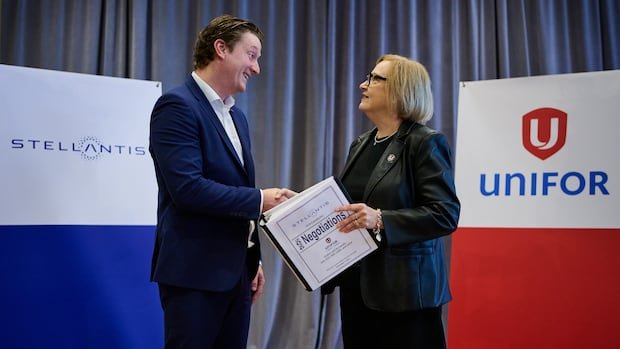

The labor union representing employees at Stellantis has cautioned the American automaker against undervaluing Canadian workers as Unifor and the company initiated discussions on the contract. This negotiation phase signifies the final round of Unifor’s talks with the Detroit Big Three automakers. Unifor typically employs pattern bargaining in its negotiations within the automotive sector, setting terms it aims to replicate with other firms.
Despite recently ratifying new collective agreements with Ford Motor Co. and General Motors in Canada, Unifor’s national president, Lana Payne, emphasized that the most significant challenge lies ahead. Payne highlighted the various obstacles faced, such as uncertainties, tariffs, and trade disputes during a news conference. She acknowledged the upcoming negotiations as potentially the toughest yet.
Both parties are striving to reach a new agreement by the September 11 deadline. Job security stands out as a primary concern for the union, particularly following the layoff of over 2,000 workers at Stellantis’ Brampton assembly plant, which has been inactive since 2023.
Recently, the union received notice indicating that Stellantis was contemplating the closure and sale of the plant, which had initially been earmarked for Jeep production. However, the plan was put on hold in early 2025, with the subsequent announcement of shifting Jeep Compass production to the U.S., contrary to the existing collective agreement.
Reiterating the concerns, Payne emphasized that the relocation of Jeep Compass production was a misguided decision that negatively impacted the Brampton facility. She called for actions to rectify the situation and expressed the importance of reinstating operations at the plant.
Stellantis acknowledged the significance of the labor discussions with the union for its future trajectory. Trevor Longley, the chairman, president, and CEO of Stellantis Canada, acknowledged the industry’s evolving landscape and highlighted the company’s substantial investments in its Canadian operations.
The negotiations are occurring against the backdrop of U.S. tariffs affecting local automakers. The looming threat of increased tariffs on vehicles, auto parts, and steel from Canada could have severe repercussions on the North American auto industry.
In response to these challenges, Unifor is actively advocating to safeguard the Canadian auto sector while pushing for fair agreements at the bargaining table. Larry Savage, a labor studies professor, highlighted the dual battle Unifor is fighting – one at the negotiation table with Stellantis and another in Ottawa to protect the auto industry from adverse trade agreements.
Amidst these efforts, Unifor announced the successful ratification of new contracts with General Motors by its members, signaling wage increases and reflecting the union’s ongoing efforts to secure favorable terms for its members.