
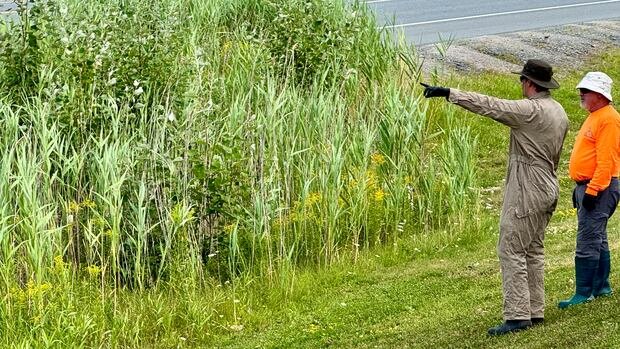

An invasive plant is expanding its reach into northern Ontario, prompting local communities to collaborate on methods to detect and manage it before it establishes a strong presence. The Junction Creek Stewardship Committee, based in Sudbury, organized a workshop in partnership with the Invasive Phragmites Control Centre to educate individuals on how to recognize invasive phragmites and prevent its proliferation. Invasive phragmites, also known as common reed, form dense stands that outcompete native plants and disrupt wetland ecosystems.
Jayden McGleish, a field supervisor at the Invasive Phragmites Control Centre, highlighted the plant’s encroachment into northern Ontario, with significant patches emerging in Sudbury. The invasive plant can overwhelm native vegetation like cattails and bulrushes, creating obstacles for wildlife. McGleish expressed concern over the challenges faced by turtles and frogs navigating through the dense patches, leading to instances where some animals have perished.
In addition to its ecological impact, invasive phragmites pose threats to recreational areas by encroaching on shorelines and impeding access. The plant’s ability to grow along roads and even through asphalt can incur costs for municipalities, damaging drainage systems and road infrastructure. While more prevalent in southern Ontario, invasive phragmites are increasingly being detected in northern regions such as Sudbury, Sault Ste. Marie, Timmins, and Thunder Bay.
Erik Barr, a contract employee at Conservation Sudbury, emphasized the importance of proactive measures to contain the invasive plant in Sudbury before it spreads uncontrollably. Educating the public on distinguishing between native and invasive phragmites is crucial for effective monitoring and management. Native phragmites in northern Ontario typically grow interspersed with other plants, whereas the invasive variety exhibits wider leaves, thicker stems, and a distinct reddish coloration on its stems.
Differentiating between the two types can also be done by examining the junction where the leaf meets the stem, as the invasive variety has a thin brown line compared to the thicker line on native phragmites. The Junction Creek Stewardship Committee stresses the need for public awareness to facilitate the identification of invasive phragmites, especially along roadways and railways where plant material can be inadvertently transported by vehicles.
Concerns are raised about the spread of invasive phragmites from metal-rich soils near Sudbury mine sites and tailings areas, with some plants originating from Copper Cliff Creek. Efforts to combat invasive phragmites involve treatments using backpack sprayers and the herbicide Timberline, which can achieve a high kill rate. While the plant may resprout the following year, proper management strategies can help mitigate its impact and prevent further spread.