
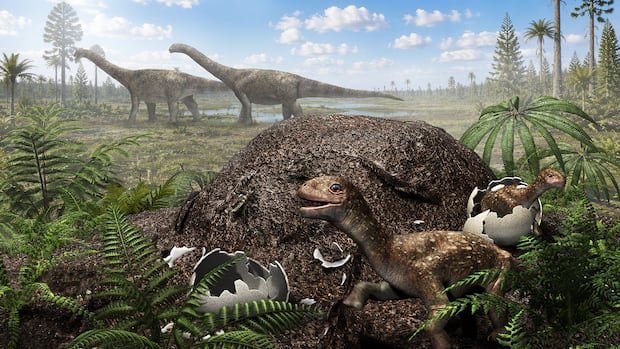

Fossil eggshells from some of the largest dinosaurs ever discovered have been unearthed in a surprisingly cool environment, far from the equator. These colossal titanosaurs, incapable of incubating their volleyball-sized eggs by sitting on them due to their size, employed an alternative method to keep the eggs warm enough for hatching.
A recent study, led by paleontologist Darla Zelenitsky from the University of Calgary along with researchers from Japan and Argentina, delved into the microscopic details of titanosaurs’ eggshells to unravel their incubation strategy. The findings suggest that titanosaurs likely utilized a similar incubation technique to modern crocodiles by burying their eggs in warm piles of decaying vegetation.
Titanosaurs, enormous plant-eating dinosaurs with long necks and tails, weighing up to 75 tonnes, roamed the Earth on four legs, resembling half the mass of a blue whale. The discovery of volleyball-sized fossil eggs associated with titanosaurs, known as Fusioolithus, was previously concentrated in warmer regions before fragments were found in the Chorrillo Formation at the southern tip of Argentina.
The Chorrillo Formation, dating back to the Late Cretaceous period, provided a glimpse into a vibrant ecosystem where titanosaurs like Nullotitan glaciaris, along with other dinosaur species, coexisted with various fauna such as crocodiles, snakes, turtles, and birds. The presence of titanosaurs’ eggs in such a distant location from the equator raised questions about their survival and reproductive strategies in challenging environments.
Dinosaurs faced the challenge of maintaining optimal egg temperature for successful embryo development and hatching, a process that could span many months. While smaller dinosaurs could brood their eggs like birds, titanosaurs had to explore alternative methods to avoid crushing their relatively small eggs due to their massive size.
The study sheds light on the remarkable adaptability of dinosaurs, showcasing their ability to thrive and reproduce in diverse environments. The research highlights the innovative ways titanosaurs overcame environmental constraints to ensure successful reproduction and nesting, emphasizing their evolutionary prowess and adaptability.