
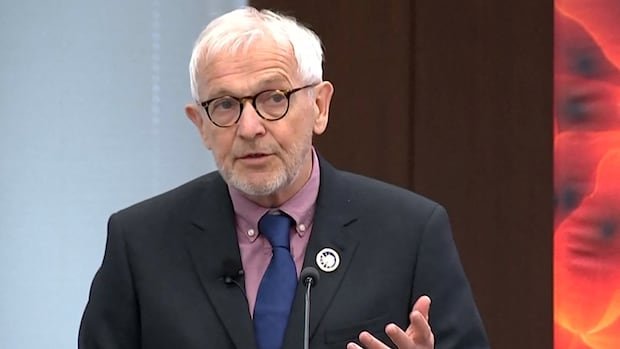

Belgian-American particle physicist Francis Halzen, aged 82, has been named as the recipient of the 2026 Nobel Prize in Physics in Stockholm. The award was granted for his significant contributions to the IceCube Neutrino Observatory and the identification of high-energy neutrinos originating from space, as stated by the awarding institution.
The IceCube Neutrino Observatory, situated at the Amundsen–Scott South Pole Station in Antarctica, was the brainchild of Halzen, who recognized the potential of using South Pole ice to track neutrinos, elusive particles that traverse the Earth and matter with minimal interaction.
Eva Olsson from the Royal Swedish Academy of Sciences described neutrinos as messengers conveying information from distant galaxies, shedding light on celestial phenomena such as exploding stars. The Nobel Physics Prize, with a value of 12 million Swedish crowns ($1.7 million Cdn), is annually conferred by the Royal Swedish Academy of Sciences.
The IceCube, covering a full cubic kilometer, commenced operations in 2011, representing the realization of a vision conceived in the late 1980s for the South Pole observatory. Halzen, associated with the University of Wisconsin–Madison, expressed gratitude to his long-term collaborators for their support over the years during a telephonic news conference.
In 2014, Halzen was dubbed “Neutrino Man” by the U.S.-based Smithsonian magazine when he received one of its Ingenuity Awards. Neutrinos, described as minuscule cosmic particles with infinitesimal mass, are constantly present, emanating from stars like the sun and passing through our bodies in vast numbers.
Halzen’s research on a unique set of neutrinos, considered cosmic messengers, provides insights into the evolution of the universe. Mark Pearce, chair of the Nobel Committee for Physics, lauded Halzen’s leadership in providing a groundbreaking instrument for scientific exploration, paving the way for a new realm of astronomy.
Plans are underway for an extension of the observatory, IceCube-Gen2, covering eight cubic kilometers of ice and set to be operational by 2033. This expansion aims to enhance neutrino detection capabilities, including the identification of weaker neutrinos, offering the potential for groundbreaking astronomical discoveries.
Belgian Prime Minister Bart De Wever commended Halzen for his dedication to unraveling cosmic mysteries through the study of neutrinos. The Nobel Prize in Chemistry, Literature, Peace, and Economics will be announced in the coming days, with laureates receiving their awards on December 10, the anniversary of Alfred Nobel’s passing.