
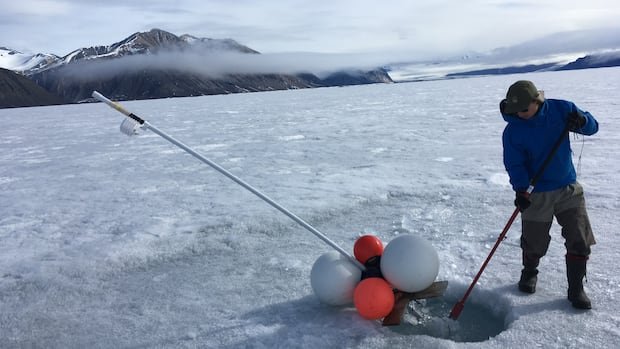

A recent study has confirmed the disappearance of Canada’s last existing epishelf lake, which was a unique ecosystem supported by a floating freshwater layer on top of saltwater. Jérémie Bonneau, an assistant professor at Laval University, expressed sadness over the loss, noting that the Milne Fiord epishelf lake on Ellesmere Island in Nunavut was the only one of its kind in Canada.
The study, published in the journal Scientific Reports, revealed the irreversible loss of the lake due to the collapse of the Milne Ice Shelf, which had dammed the mouth of the fiord for thousands of years. This unique phenomenon, existing for over 4,000 years, showcased the impact of climate change on the Arctic region.
The lake’s ecosystem, with distinct communities of bacteria, viruses, and phytoplankton in the freshwater and saltwater layers, reflected a rare environment where life thrived in separate domains within the same water column. The disappearance of the lake following the ice shelf collapse led to the immediate mixing of freshwater and seawater, resulting in the loss of unique organisms that inhabited the lake.
Researchers highlighted the significant ecological impact of the lake’s disappearance, as it not only supported diverse microbial life but also provided nutrients to an ecosystem thriving beneath the ice shelf. The study emphasized the transformative effects of environmental changes on delicate ecosystems and the urgent need for conservation efforts to protect such natural wonders.
While epishelf lakes have vanished from Canada, similar formations still exist in Greenland and Antarctica. However, researchers warn that these ecosystems are also at risk due to ongoing environmental changes, underscoring the importance of preserving Earth’s diverse and fragile habitats.