
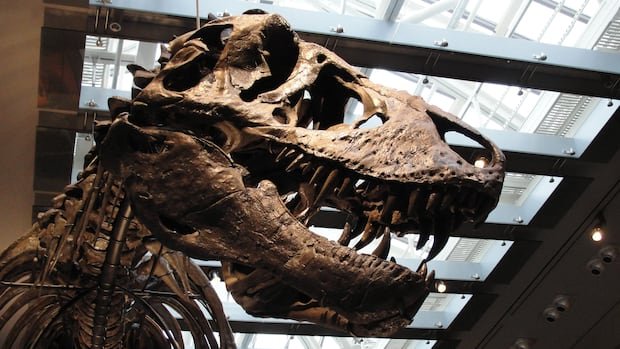

Scientists have debated for a long time whether certain dinosaurs were warm-blooded. Now, a new study reveals that researchers have utilized chemistry to determine the body temperature of two T. rex specimens.
Aradhna Tripati, a professor and geochemist at the University of California, Los Angeles, explained the challenges of this research. She co-authored the study published in the journal Science Advances and discussed the methodology with CBC’s Quirks & Quarks.
To measure the temperature of extinct animals like dinosaurs, scientists employed a method based on chemical variations in certain hard tissues such as tooth enamel and eggshells. By analyzing the mineral bioapatite in these materials, researchers could estimate the body temperature of ancient creatures by comparing isotope clumping with living animals.
Past studies by UCLA scientists indicated that titanosaurs and oviraptors were warm-blooded. In the recent study, the researchers successfully estimated the body temperature of T. rex by analyzing tooth enamel samples obtained from a young adult T. rex named Thomas. The analysis suggested that T. rex had a body temperature ranging from 33.8°C to 38.8°C, similar to large mammals and possibly flightless birds like ostriches.
Understanding the body temperature of T. rex sheds light on its behavior and habitat preferences. The findings suggest that a warm-blooded T. rex could have inhabited diverse environments, including the Arctic. This study has implications for how dinosaurs, especially predators like T. rex, adapted to different climates.
The research has garnered praise from experts in the field, like paleontologist Anthony Fiorillo, who noted the significance of the study in understanding dinosaur physiology. While the study provides valuable insights, there are ongoing discussions about the metabolic characteristics of T. rex compared to modern warm-blooded animals.
Overall, the study contributes to our understanding of dinosaur biology and how these ancient creatures thrived in various environments, providing new perspectives on their evolutionary adaptations.