
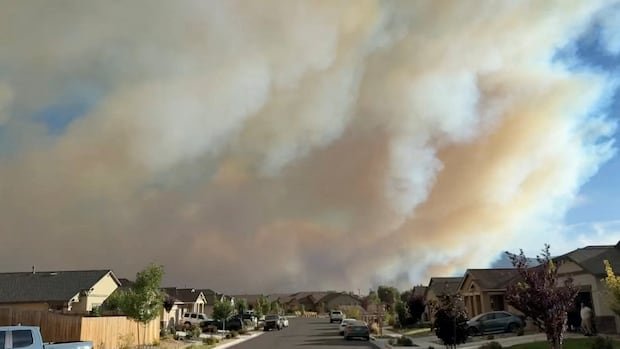

A rapidly spreading wildfire in northwest Reno, Nevada, destroyed homes on Sunday, posing challenges for firefighters trying to contain the blaze due to shifting winds. Approximately 90,000 individuals were urged to evacuate as the fire, known as the Hawk Fire, engulfed over 60 square kilometers in the Peavine Peak area of the Humboldt–Toiyabe National Forest.
The authorities reported that at least six individuals, including three first responders and three civilians, sustained injuries. While the fire was determined to be “human-caused,” specific details regarding the cause were not disclosed.
With the “GO NOW” evacuation zone expanding to encompass around 42,000 residents, reaching the vicinity of the University of Nevada, an additional 45,000 individuals were placed in an evacuation warning zone. Washoe County Sheriff Darin Balaam urged all affected individuals to evacuate immediately and be prepared for an extended absence, as the fire’s behavior was expected to become more erratic due to changing wind patterns.
Amid the chaos, one resident, Cari Kieffer, recounted the heart-wrenching moment of witnessing her home reduced to ashes, leaving her and her family with nothing but devastation. The family scrambled to evacuate as the wildfire rapidly approached their neighborhood, with Kieffer managing to salvage only a few belongings amidst the chaos.
The situation prompted Nevada Governor Joe Lombardo to declare a state of emergency in Washoe County, mobilizing the Nevada National Guard to provide aerial firefighting support and assist in safeguarding evacuated areas. The deployment of 800 fire personnel and the closure of sections of U.S. Route 395 were among the measures taken to combat the fire’s advance.
As the fire continued to spread, emergency officials opened shelters for evacuees, although restrictions on bringing pets posed additional challenges. The community rallied together, with local casinos offering accommodations to those displaced by the wildfire.
The devastating impact of the Hawk Fire highlighted the urgent need for coordinated efforts to combat wildfires in the region, as residents grappled with the sudden destruction of their homes and livelihoods. The rapid escalation of the fire underscored the unpredictable nature of wildfires in the face of changing environmental conditions.