
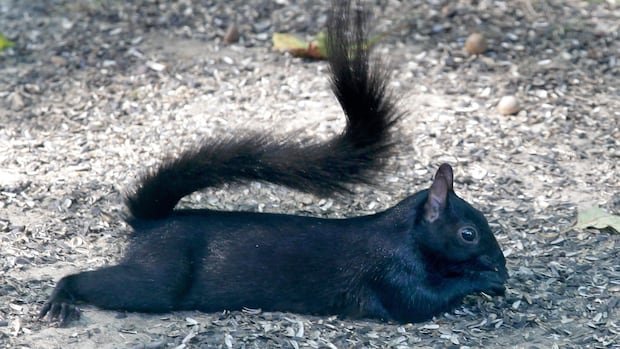

Francis Quang-Hai Dinh spent his first summer at McGill University exploring Montreal’s parks on his bicycle, on a mission to observe squirrels. He meticulously documented over 800 grey and black squirrels in almost 200 green spaces spanning from Mirabel to Saint-Bruno. What began as a simple assignment evolved into a passion project to understand how the city’s geography and waterways influence evolution.
Dinh, an integrative biology student at the University of Illinois Urbana-Champaign, found that the prevalence of black squirrels increases as you head north from Montreal. In areas just beyond Laval, up to 40% of squirrels were black, compared to around 20% on Laval Island, 15% on Montreal Island, and only 2-3% on the south shore of Montreal. This variation is primarily attributed to temperature differences, with black squirrels benefiting from their darker coloration in cooler climates.
The study also highlighted the role of forest cover in squirrel coloration, noting that denser tree canopies provide better camouflage for black squirrels. Allison Roth, the study’s lead author, emphasized that the research focuses on using squirrels as a model to explore how urban environments drive evolutionary changes, rather than just studying the squirrels themselves.
Montreal’s distinct layout, characterized by the St. Lawrence River and its tributaries, creates unique environmental niches that can lead to genetic and physical adaptations in local wildlife populations. This fine-scale variation is crucial for understanding urban evolution dynamics. The study delves into the intricate interplay between urbanization, local vegetation structure, and climate in shaping wildlife adaptations.
While previous research often compared urban and rural areas broadly, this study delves into neighborhood-specific changes. It challenges the notion that human development alone drives wildlife adaptations, highlighting the multifaceted influences of urban sprawl, microclimatic variations, and natural barriers like rivers. The research is part of a broader initiative by ecology journals to explore how collaborative data analysis can address key ecological questions.
Dinh reflected on how this research has changed his perspective on wildlife and urban environments, emphasizing the coexistence of nature and city life. He pointed out the resilience of wildlife in adapting to human modifications, underscoring the interconnectedness of urban spaces and natural habitats.