
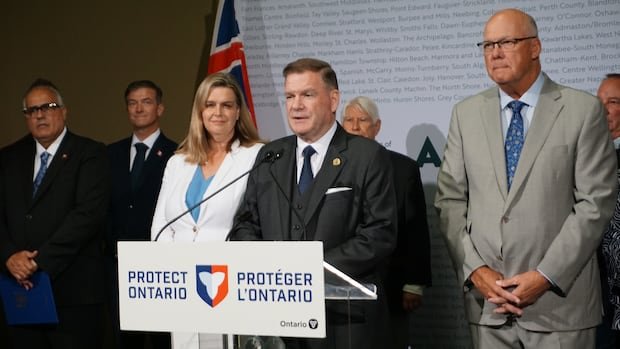

The Ontario and Canadian governments have allocated $1 billion to assist municipalities that do not impose development charges in constructing and refurbishing essential infrastructure. This initiative was disclosed by Todd McCarthy, Ontario’s acting minister of infrastructure, Rob Flack, Ontario’s minister of municipal affairs and housing, and Jennifer McKelvie, parliamentary secretary to the federal minister of housing and infrastructure at the Association of Municipalities of Ontario (AMO) conference in Ottawa.
Both levels of government will contribute $500 million each to establish a new stream under the Municipal Housing Infrastructure Program (MHIP). This particular stream, aimed at municipalities without development charges, aims to support these communities in funding infrastructure projects such as bridges, roads, and water systems to facilitate new housing developments and safeguard the existing housing supply.
McCarthy expressed optimism about the collaboration between federal and provincial governments and municipalities in achieving common goals, describing the funding as a positive development. Initially, there was a misconception that the $1 billion was separate from the $8.8 billion commitment made in March, but it was later clarified that the new funding was part of the existing $8.8 billion agreement.
Notably, the Ontario government has already earmarked up to $1.5 billion to assist the City of Toronto in offsetting reduced development charges, while the City of Ottawa intends to slash development charges by 54% to secure $478 million in infrastructure funding.
Premier Doug Ford emphasized the high demand for funds compared to the available resources during a speech to municipal leaders, urging further reductions in development charges and promising additional funding if required. Meanwhile, the first round of applications for the new funding stream will open on October 29, with project selections expected in the spring.
Mississippi Mills Mayor Christa Lowry, who chairs the Rural Ontario Municipalities Association (ROMA), commended the funding, highlighting that over 200 of Ontario’s 444 municipalities do not collect development charges. She emphasized the readiness of these communities to grow but acknowledged the challenges in realizing their ambitious plans.
McCarthy underscored the importance of the funding stream in bolstering local economies amidst uncertainties surrounding U.S. tariffs. He pointed out that high infrastructure costs often hinder new housing developments, especially in municipalities facing repair backlogs, escalating construction expenses, and limited funding sources for critical projects.
Robin Jones, outgoing president of AMO and mayor of Westport, Ontario, praised the initiative, noting the unique infrastructure challenges faced by rural, small, and northern communities. The OBCM group also reiterated their call for stronger provincial action to address homelessness and addiction issues, advocating for the establishment of a dedicated ministry for addictions, expanded treatment options, and potential declarations of a state of emergency.
The AMO conference in Ottawa, where discussions on these critical matters are taking place, will feature a keynote address by Ontario Premier Doug Ford on Monday morning.