
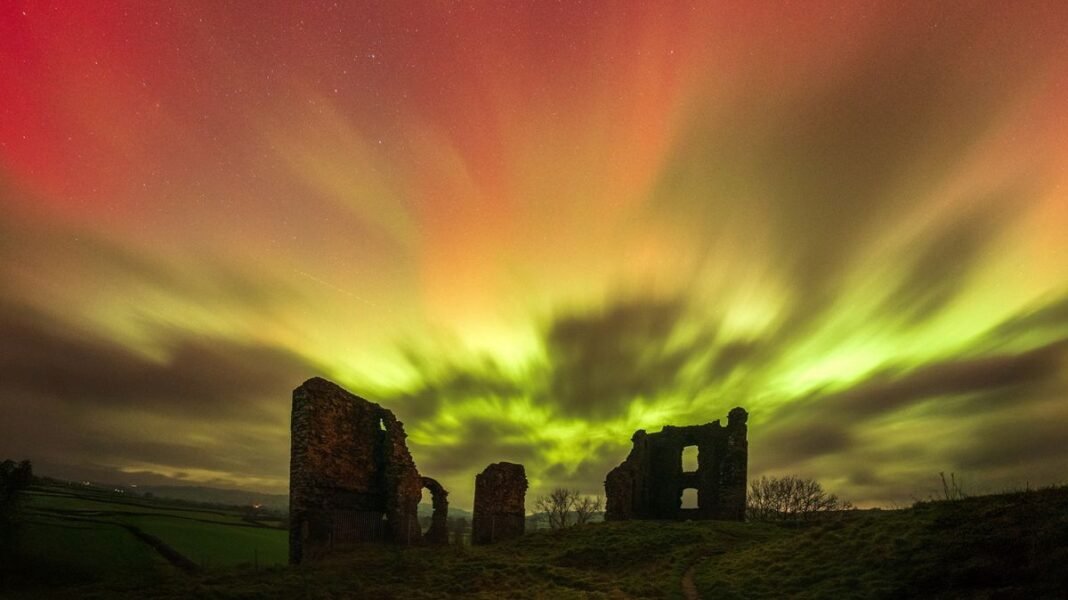

The Northern Lights are set to appear in the skies of the UK tonight due to a powerful solar storm, extending the usual reach of this mesmerizing natural phenomenon. Since Monday, the country has experienced heightened auroral activity caused by a severe Coronal Mass Ejection (CME) from the sun. This unusual event has brought the stunning display further south than usual, even reaching parts of the US like New Mexico.
In the UK, the lights have been observed further south, creating a beautiful spectacle of red and green hues in select areas, as reported by the Met Office. Certain regions are more favorable for viewing the Northern Lights.
Recent sightings of the aurora have been reported in parts of Cornwall, Scotland, and northern England, with Scotland being a common location for such displays, especially in the north. The Met Office anticipates similar occurrences tonight, depending on weather conditions.
The Met Office forecasts the arrival of another CME today, likely affecting the same regions as before. The agency predicts a decline in auroral activity by the evening of January 20 UTC, with potential visibility in parts of Scotland, Northern Ireland, and similar latitudes with clear skies.
While the remarkable display from Monday is not expected to continue on Tuesday, the Met Office suggests that the best viewing times for the aurora will be between 6 pm and 11.59 pm in the northernmost regions of the UK.
The forecast indicates that the aurora might still be visible in parts of Scotland and Northern Ireland on Tuesday evening, although cloudy conditions could limit sightings. For the aurora to be visible further south, a solar storm of Kp level 8 or 9 would be required.
The Met Office’s current red warning indicates that the activity tonight will likely reach a Kp7 level, remaining primarily in the northern regions.
The agency explains that Kp8 or 9 activity is considered “extreme” and is needed to bring the aurora belt southward over the UK. This level of geomagnetic storm is rare, with moderate to strong storms (Kp6-7) typically causing the aurora borealis to move southwards across Iceland or towards the Faeroes, faintly visible from the UK due to their high altitudes.