
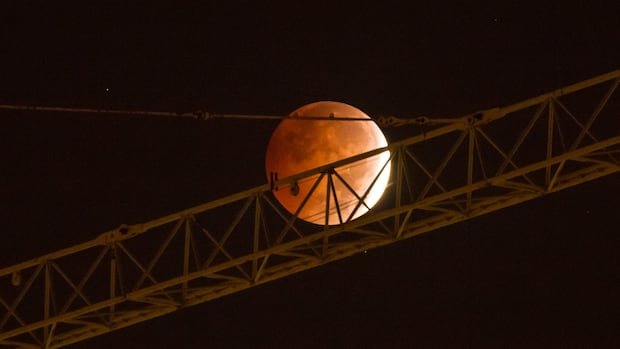

On the night of August 27-28, a partial lunar eclipse will be visible throughout the country. This eclipse follows the total solar eclipse seen in Iceland, Spain, and a portion of Portugal about two weeks prior. Although it will be a partial eclipse, it will have significant coverage, reaching up to 93 percent at its peak. Lunar eclipses occur when the moon passes through Earth’s shadow, known as the umbra, after initially passing through the penumbra, a fainter outer shadow that is harder to see with the naked eye.
Most areas in Canada will witness the complete duration of the eclipse, while Western Canada will observe the partial eclipse already in progress as the moon rises. Unlike solar eclipses, protective eyewear is not necessary to view lunar eclipses. Furthermore, lunar eclipses unfold over hours rather than minutes. The upcoming lunar eclipse on August 27-28 will be visible across North and South America.
The eclipse will commence as the moon enters Earth’s penumbra around 10 p.m. ET, but the visible phase will start at 10:33 p.m. ET on August 27 and conclude at 1:52 a.m. on August 28. The deepest stage of the eclipse is expected at 12:13 a.m., with most of the moon appearing darkened. This event is just one of several astronomical occurrences this month, as noted by Elaina Hyde, director of the Allan I. Carswell Observatory at York University’s department of physics and astronomy in Toronto.
Regarding the eclipse’s appearance, Hyde mentioned that although it will not result in a fully red “blood moon,” parts of Canada may witness a reddish hue. Lunar eclipses are easily observable with the naked eye, and for those with binoculars, a small telescope, or a smartphone camera with a good night mode, capturing quality images is possible.