
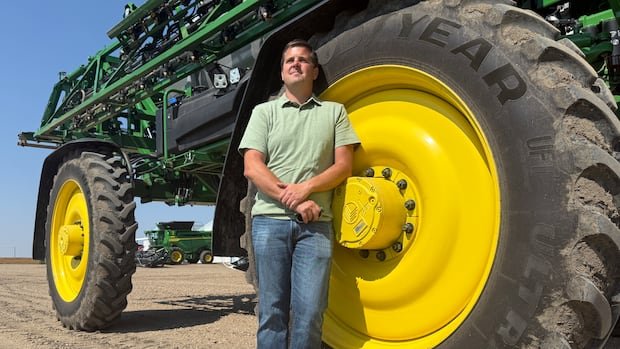

In Coleville, Saskatchewan, Dean Roberts observed a large grey drone soaring above his expansive 4,000-hectare farm, which cultivates various crops such as canola, wheat, barley, and lentils. The drone in question was the DJI T100, the largest spray drone currently permitted in Canada, equipped with a 100-liter tank approved by the federal government for spraying pesticides.
During a demonstration, the drone’s tank was filled with water as it maneuvered across the fields. Roberts highlighted the potential benefits of this technology for his farming operations, especially in situations where traditional ground equipment struggles due to wet conditions, such as when applying fungicide to control leaf diseases on lentils.
Roberts emphasized that the drone represents the continuous technological advancements adopted by prairie farmers to enhance crop productivity. However, he noted that Canada lags behind other nations like the U.S., China, Brazil, Japan, and Australia in permitting drone spraying.
Regulatory obstacles have hindered the adoption of agricultural technology in Canada, according to Roberts. Factors such as bureaucratic red tape, inadequate infrastructure, and labor shortages have impeded the country’s agricultural competitiveness on the global stage, leading to slower growth in agri-food exports compared to other countries.
Experts, including Evan Fraser from the Arrell Food Institute, have pointed out that Canada’s market share in global food trade has declined, and the country risks falling in the global food export rankings. Despite an increase in food exports over the years, Canada’s export growth rate has not kept pace with international competitors.
Roberts and Evan Shout, CEO of Maverick Ag, highlighted challenges related to infrastructure and labor issues in the agricultural sector. Roberts underlined the difficulty in transporting crops to global markets, mainly relying on railways for export. Delays in rail transport can cause bottlenecks, affecting the timely delivery of crops to grain elevators.
Shout emphasized the importance of infrastructure improvement and labor availability for addressing industry challenges. He stressed the need for farmers to have a voice in policy decisions to enhance the agricultural sector’s efficiency and competitiveness.
Looking ahead, Fraser suggested that Canada should prepare to become a more significant agricultural power, especially considering the potential impact of climate change on global agricultural productivity. Fraser emphasized the need for Canada to position itself as a sustainable agricultural leader, focusing on eco-friendly practices and supporting global food security initiatives.
In conclusion, Roberts expressed confidence in Canada’s agricultural potential, citing the country’s vast arable land and favorable climate for farming. He believed that Canada could contribute significantly to global food production, although challenges such as infrastructure limitations and labor shortages must be addressed to unlock the country’s full agricultural potential.