
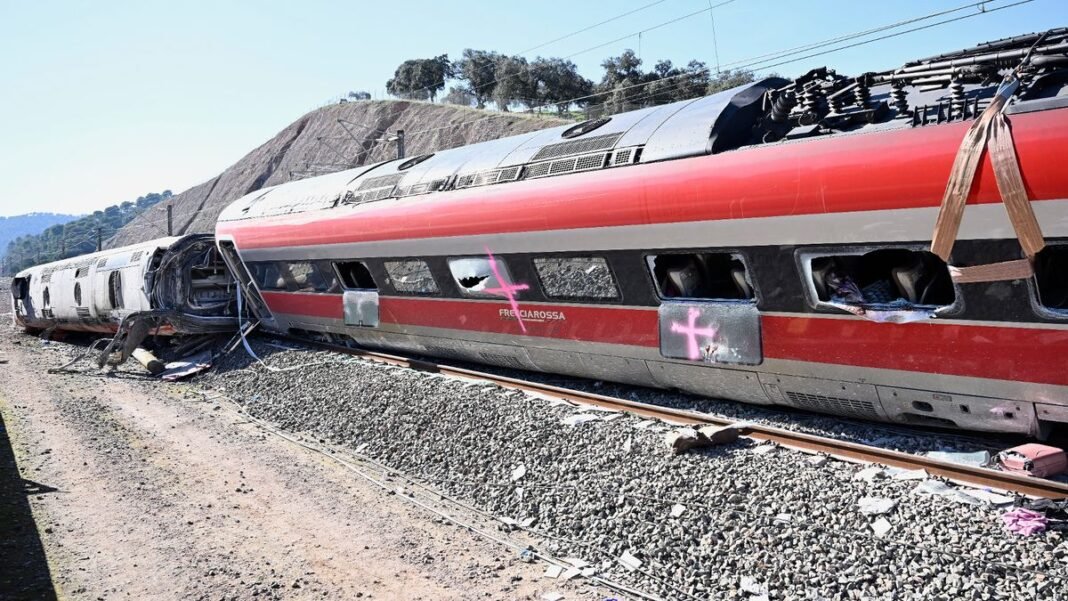

An inquiry into a tragic train incident that resulted in the death of 45 individuals has revealed the presence of fractures on the railway track. The initial findings by the Railway Accident Investigation Commission (CIAF) indicated the existence of “nicks” on the train wheels and “deformations” on the tracks in Cordoba, a city in southern Spain, where the collision occurred. These observations are in line with a potential track fracture.
The collision in Adamuz, which involved two trains traveling at approximately 130mph (209kmh), also left over 150 people injured. Samples of the rail will undergo laboratory testing to ascertain the potential causes of the track fracture, with the accident commission not dismissing any possibilities.
Speculation suggests that the track fracture likely occurred before the Iryo train, involved in the accident, passed over it, leading to the derailment. The incident took place at 7.45pm on a Sunday when a train carrying 289 passengers from Malaga to Madrid derailed and collided with an incoming train from Madrid to Huelva. The impact was most severe on the front of the second train, causing the first two carriages to veer off the track and plunge down a four-meter slope. Some casualties were discovered hundreds of meters away from the crash scene, as reported by Andalusia regional President Juanma Moreno.
Images displayed the separated remains of the initial two cars of the second train lying beside the tracks. Train seats were thrown onto the rocks below the tracks. Meanwhile, Civil Guard officers inspected the first train’s interior with the help of dogs, while passengers’ belongings were scattered on the floor. Mr. Moreno expressed deep sorrow over the tragedy, emphasizing the significant impact on the province of Huelva, from which a majority of the deceased individuals hailed.
Within two days of the Cordoba incident, a commuter train in Barcelona collided on Tuesday after a retaining wall collapsed onto the tracks, resulting in one fatality and 37 injuries, as confirmed by Spanish regional authorities.