
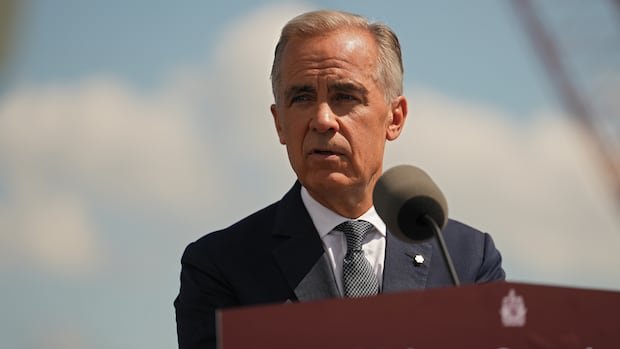

At an upcoming investment summit in Toronto, Prime Minister Mark Carney will present 167 potential investment opportunities, including a floating LNG terminal in British Columbia, a high-speed rail line linking Edmonton and Calgary, and a pipeline from Alberta to the Pacific Ocean. These opportunities are detailed in a 66-page prospectus obtained by CBC News, providing insight into the investment prospects that Ottawa and Canadian business leaders aim to highlight during the event.
Scheduled for September 14 and 15, the summit, organized by the Prime Minister in collaboration with the Canada Pension Plan Investment Board and Public Sector Pension Investment Board, aims to attract $1 trillion in investments by bringing together international investors and Canadian business leaders.
The projects are categorized into eight investment areas, covering conventional energy, clean energy, mining, marine and port infrastructure, power and utilities, digital technology, advanced manufacturing, and transportation. Each project description includes its current stage, required capital expenditure, and the type of investment needed for development.
Among the notable projects are the $57 billion US expansion of the Port of Churchill, a $44 billion investment in Nova Scotia’s Wind West offshore wind project, a proposed $35 billion West Coast oil pipeline from Alberta to British Columbia, and the $28.5 billion Ksi Lisims LNG terminal project.
The investment opportunities also feature projects in various sectors, such as a float glass manufacturing facility in Manitoba, expanded manufacturing capacity for defense-related night-vision technology, and satellite technology for Earth observation.
Some projects, like the Ksi Lisims LNG terminal, are ready for immediate development, while others, such as a graphite project in Saskatchewan, are still in the early stages of assessment.
In the prospectus, plans are outlined for a $57 billion US expansion of the Port of Churchill, aiming to establish a robust trade gateway. Additionally, there is a $10.9 billion proposal for a high-speed rail line connecting Calgary and Edmonton, as well as a $35 billion oil pipeline project linking Alberta’s crude production to a deepwater export terminal in southern British Columbia.
The document also includes a $2.1 billion US proposal for South Bow’s Prairie Connector pipeline expansion, which repurposes parts of the previously canceled Keystone XL pipeline for transporting Canadian crude to US refining markets.
Furthermore, the prospectus highlights a $28.5 billion pitch for the floating Ksi Lisims LNG export facility in British Columbia, reflecting efforts to diversify Canada’s energy exports beyond the US market. Clean energy proposals feature nuclear power generation, carbon capture, and wind power projects in different provinces.
Additionally, the document emphasizes Canada’s leadership in artificial intelligence, showcasing investment opportunities in data centers and quantum computing technology, positioning the country as a pioneer in these innovative fields.