
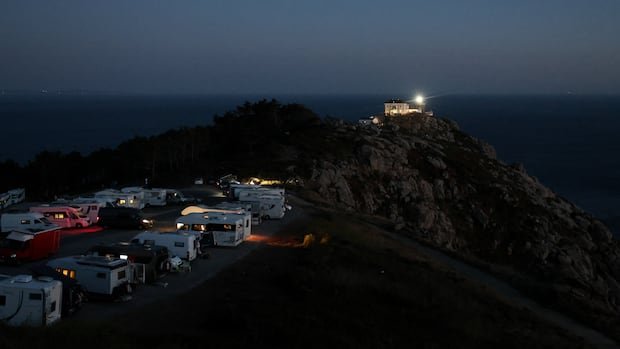

Hundreds of thousands of travelers have flocked to Spain to witness the solar eclipse happening on Wednesday. However, the event coincides with high temperatures and an increased wildfire risk in the country, raising concerns for authorities aiming to prevent any fire damage linked to the surge in astrotourism.
Virginia Barcones, the secretary general for civil protection and emergencies at Spain’s Interior Ministry, expressed the need to be cautious due to the challenging summer marked by severe forest fires in Spain. The country has already witnessed around 400 fires burning over 603,000 acres of land this year, as reported by the European Forest Fire Information System.
To avoid adding to the fire crisis, authorities are deploying 35,000 officers on Wednesday to monitor large outdoor gatherings, aiming to detect and suppress any potential fires. Spain is a prime location for viewing the solar eclipse, with the path of totality spanning across northern Russia, eastern Greenland, western Iceland, northeastern Portugal, and a significant part of northern Spain, culminating at the Balearic Islands.
Only individuals within the path of totality will observe the full coverage of the moon over the sun. While a partial eclipse will be visible in Canada, viewers are reminded to use protective eclipse glasses. This solar eclipse marks the first time in 120 years that a full eclipse will be visible from mainland Spain, sparking a surge in travel interest.
Special measures have been put in place for the eclipse, with over 660 official viewing sites designated by regional governments to accommodate the expected influx of over 440,000 individuals. The event is anticipated to contribute significantly to Spain’s economy, with an estimated 347 million euros in economic impact.
Despite the ongoing heatwave and wildfire concerns, eclipse enthusiasts remain undeterred. Jan Cami, a professor at Western University, emphasized the awe-inspiring nature of the eclipse, noting that it often leads to plans for future celestial event trips. The eclipse is just the beginning of a series of solar eclipses set to be visible from Spain in the coming years, with potential for increased astrotourism.
Authorities are urging caution as Spain faces dry conditions and high fire risks, with wildfires still active in various provinces. The Forest Fire Index is expected to reach critical levels on the day of the eclipse, posing a heightened risk. AEMET forecasts soaring temperatures on eclipse day, emphasizing the need for vigilance to prevent wildfires.
Overall, the eclipse fervor remains strong among travelers, with hopes that the event will not only offer a spectacular natural phenomenon but also raise awareness about the impacts of climate change. The solar eclipse in 2026 is just the start of a series of celestial events that promise to attract more astrotourism to Spain in the near future.