
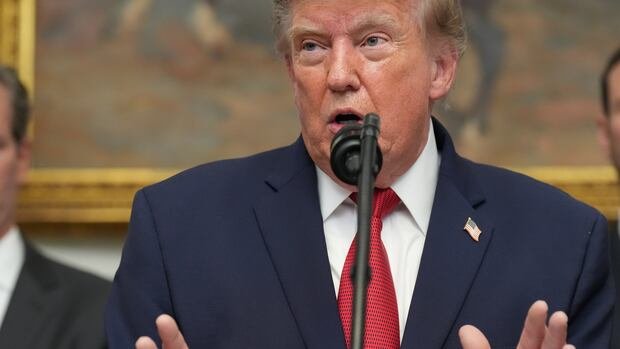

U.S. President Donald Trump declared on social media Wednesday his intention to implement what he described as the “MOST DEVASTATING ECONOMIC OPERATION EVER UNDERTAKEN AGAINST ANY NATION!” “This will entail Economic Warfare and Isolation on an unparalleled level,” he stated on Truth Social, providing minimal specifics. He also cautioned about the economic repercussions for any country supporting Tehran or extending assistance to Iran. “ANY country that permits its financial institutions, businesses, airports, or government entities to offer any form of assistance to Iran will face SIGNIFICANT Economic Ramifications,” Trump emphasized in a social media post. He refrained from outlining the specific measures the U.S. government would take against such nations, nor did he mention any country by name. Trump emphasized the need to halt activities such as oil smuggling, swap lines, cash transfers, exchange houses, ship registries, and front companies immediately. Thousands of casualties have been reported in the six-month-long conflict that involved nations across the Gulf. Global markets were rattled as Iran demonstrated its control over shipping in the Strait of Hormuz, a crucial route through which approximately a fifth of the world’s traded oil passed prior to February. Despite two ceasefire agreements announced by the U.S. and Iran in April and June, aimed at restoring shipping activities through Hormuz, these agreements quickly collapsed, even as Israel largely pulled back from the conflict initiated with U.S. involvement in February. Trump’s social media declarations and threats are not always translated into tangible actions as stated. Conflicting reports emerged regarding U.S.-Iran talks. The United Arab Emirates, hosting a significant U.S. military base, declared the suspension of all trade activities, commercial exchanges, and financial transactions with Iran until further notice on Tuesday. This decision followed a report by the UAE defense ministry claiming the detection of two missiles launched from Iran that landed in the sea, a report dismissed by Iran as groundless. China is identified as purchasing over 80% of Iran’s shipped oil, according to 2025 data from analytics firm Kpler. Engaging in further economic hostilities with China poses risks given its status as a major exporter to the U.S., including vital rare-earth minerals. Mohammad Mokhber, an adviser to Iran’s supreme leader, expressed Iran’s willingness for dialogue with the U.S. while emphasizing that negotiations should not be perceived as surrender, as reported by the semi-official Fars news agency. Trump denied any ongoing talks with Iran on Tuesday, contrasting with Jared Kushner, Trump’s son-in-law and special envoy, who stated a day earlier that discussions with Iran were still ongoing and possibly more substantive than ever.